

17 Feb FOUNDER: Honoring a Legacy and Saving Lives
Channeling tragedy into a new sense of purpose
by Tamara E. Holmes
 For Kathryn Cross, the year 2021 was transformative, to say the least.
Her 19-year-old brother, Andrew, passed away in February of that year, following a battle with cerebral palsy. She would sometimes wonder whether he could have been saved, since her family discovered research suggesting that Andrew might have survived had he been able to receive an infusion of his own umbilical-cord blood.
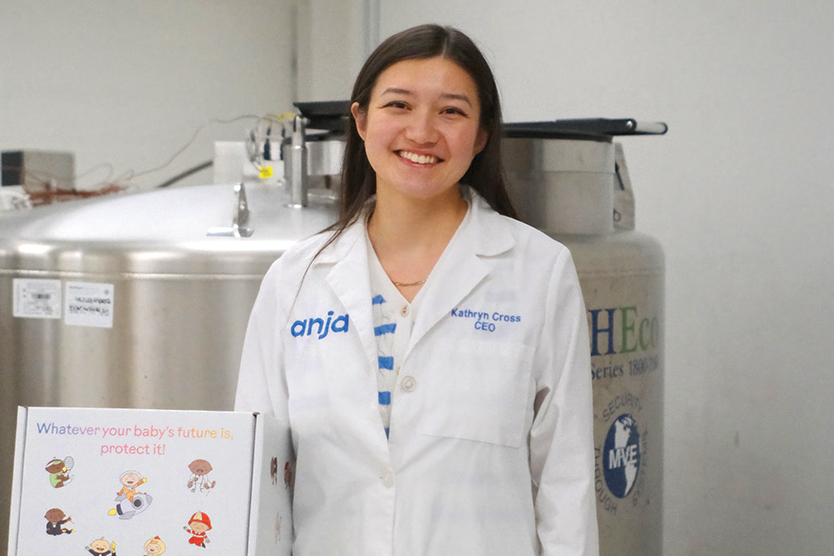
Cross, 26, didn’t want other families to experience the pain she was enduring, so that same year she channeled her grief into creating Anja Health, a company that allows parents to store a baby’s stem cells in a lab. “I wanted to do something that would’ve helped Andrew and also have the maximum amount of impact,” she says.
Cord blood stem cells have been used to treat such diseases as cancer and sickle cell anemia. They’re being studied as a treatment for cerebral palsy, autism, lupus, and a range of other conditions. While it’s possible to find a stranger whose genetic makeup is similar enough that their stem cells can be used, it’s typically difficult, and even more so for people of color. When parents store their baby’s cord stem cells, they ensure later access to the cells, giving their child the best chance of surviving a major illness.
In starting the business, Cross learned that many parents don’t understand how cord and placenta stem cells could aid their children in the future. “I felt like I would be a good person to help bridge that knowledge gap, so I started making TikToks, and they went viral pretty quickly,” she says.
Not only did she pique the interest of parents, but she caught the attention of investors, with the company raising $4.5 million in venture capital.
Finding investors was like dating, Cross says, because she was looking for people who aligned with her values. “I also wanted investors who really seemed to care about the end users, who for us were pregnant parents,” she says.
One of her biggest challenges in the four years since starting her business has been learning how to be an effective manager. She has learned on the job, however, proving that experience is often the best teacher.
As she continues to build her business, each step is a way of keeping Andrew’s memory alive. She recently read about the concept of “the glass child,” a term used to describe the feeling of responsibility often felt by the sibling of a child with a chronic illness or a disability. She says the description fits her to a T.
“I think that’s been integral to who I am today,” she says.
Finding investors was like dating, Cross says, because she was looking for people who aligned with her values.