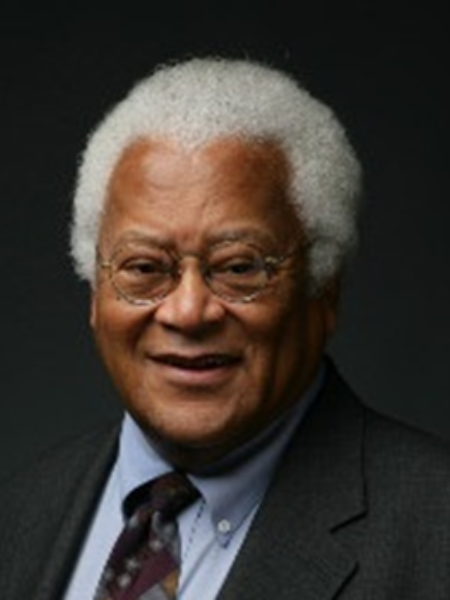
Rev. James M. Lawson, Jr.
Civil Rights Icon and Pastor Emeritus, Holman United Methodist Church
Rev. James Lawson, Jr., a coveted leader of the United States Civil Rights Movement has devoted his adult life to seeking peace, equity, and justice for all. He grew up in Ohio, and like both his father and grandfather, Lawson became a Methodist minister his senior year of high school. He would later marry his wife, Dorothy, and they had three sons.
Rev. Lawson attended Baldwin Wallace College in Berea, Ohio, where as a freshman, his refusal to serve in the US military when drafted, resulted in his conviction for draft evasion and a two-year prison sentence. After serving 13 months, Rev. Lawson returned to Wallace College and finished his degree. Soon after, Lawson joined the Fellowship of Reconciliation (FOR) and the Congress of Racial Equality (CORE), each of which advocated for nonviolent resistance to racism.
and later served as a missionary in Nagpur, India where he studied core tenets of nonviolent resistance developed by Mohandas Gandhi. Upon his return to the US in 1956, Lawson entered Oberlin College’s, Graduate School of Theology where he was introduced to Dr. Martin Luther King, Jr., who also adhered to Gandhi’s nonviolence principles.
After being urged by Dr. King to move to Nashville, Tennessee to work in the movement, Lawson conducted workshops on nonviolent protest methods, and began his studies at Vanderbilt University’s, Divinity School for two years before he was expelled in 1960 due to his civil rights advocacy and arrests. Some of Rev. Lawson’s most noted social and worker justice activism included:
· Provided nonviolence and spiritual guidance to the Little Rock Nine, Black students at the forefront of the US school desegregation efforts when they tested the Supreme Court’s Brown v. Board of Education decision.
· Organized the 1960 Nashville, Tennessee sit-ins aimed at desegregating lunch counters nonviolently.
· Led the 1961 Freedom Rides, protesting Southern segregated bus terminals, which galvanized supporters across myriad cultures.
· Organized the 1963 Birmingham Campaign challenging segregation throughout Alabama.
· Advised and counseled leaders during the 1968 Memphis Sanitation Workers strike and helped to bring his close friend and fellow minister, Rev. Dr. Martin Luther King, Jr. to Memphis for the demonstration, where he was later tragically assassinated.
Following his pivotal leadership throughout the 1950’s and 1960’s Civil Right’s Movement, Rev. Lawson continued his social activism and ministerial efforts, which later led him to Los Angeles, CA where he served as the Senior Pastor of Holman United Methodist Church until his retirement in 1999.
Decades after his expulsion, Vanderbilt University apologized and welcomed Rev. Lawson back as an honored professor and launched the James Lawson Institute for the Research and Study of Nonviolent Movements. In 2022, UCLA also renamed their renowned labor center to the UCLA James Lawson Jr. Worker Justice Center.
Rev. Lawson’s iconic servant leadership was portrayed in the 2013 motion picture, The Butler, which chronicled his nonviolent protest methods trainings during the 1950’s and 1960’s. Rev. Lawson’s historic fight for workers was depicted in the film, Love and Solidarity: Rev. James Lawson and Nonviolence in the Search for Workers Rights by Michael K. Honey.
At 94 years young, Rev. Lawson continues to embody the values of, “The Beloved Community,” a community in which everyone is cared for, absent of poverty, hunger, and hate.